Work / Thermawood Tasmania
Operations platform, Launceston
Thermawood Tasmania
Not a website. A fully custom operations platform that semi-automates a back office, from the first customer enquiry through to the final invoice.
- SERVICES
- Quoting · Job scheduling · Xero sync · Job sheets · Customer SMS · Glass ordering
- ENGAGEMENT
- Ongoing
- YEAR
- 2026
The challenge
Thermawood Tasmania retrofit double glazing into existing timber windows. The work is measured, quoted, scheduled, installed and invoiced, and every one of those steps used to live in a different place. Quotes in a spreadsheet. Jobs in a calendar. Invoices in Xero. Nothing talked to anything else.
Quoting was the worst of it. A quote meant opening last month's spreadsheet, copying the closest job, retyping the measurements, checking the glass pricing against a supplier PDF, then pasting the total into an email. A quote sent yesterday could not be found today without knowing who saved it and where.
Under all of it sat the same problem. The business ran on spreadsheets, an inbox and memory, and memory is the one that fails quietly.
What we built
We built one platform and moved the business onto it a piece at a time, starting with quoting, because that was where the pain was worst.
Now a quote is built from the customer record, priced against the glass rates held in the system, sent as a tracked document, and it stays attached to that customer forever. Accepting it creates the job. Nothing is retyped, and nothing has to be found again.
The Xero sync had to run both ways. A one-way push would have been simpler, but the business does not raise every invoice inside the app. Payments come in, credit notes get issued, and an accountant makes adjustments at the Xero end. If those never came back, the app would have been confidently wrong about who owed what within a fortnight, and nobody would have trusted it again.
Job sheets replaced a printed page and a phone call. The installer used to arrive with a sheet that was accurate on the morning it was printed. Job sheets now carry version history, so a change made in the office at nine is on the sheet at the job at nine, and the old version is still there to check against.
It was built in production, a piece at a time, rather than as one launch. A big-bang cutover would have meant months of building against a guess, then asking a working business to change everything it does on a single Monday. Instead each module went live the week it was ready, got used in anger, and got corrected while the detail was still fresh. The business was never offline and never had to run two systems in parallel.
What is in it
Grouped the way the work runs, from the first enquiry through to the last invoice.
01 / Enquiry and customer
Everything that arrives from a customer lands somewhere it can be worked on.
- A shared inbox that turns an incoming enquiry into a record instead of an email somebody has to remember
- A customer database holding the full history of every quote, job and conversation
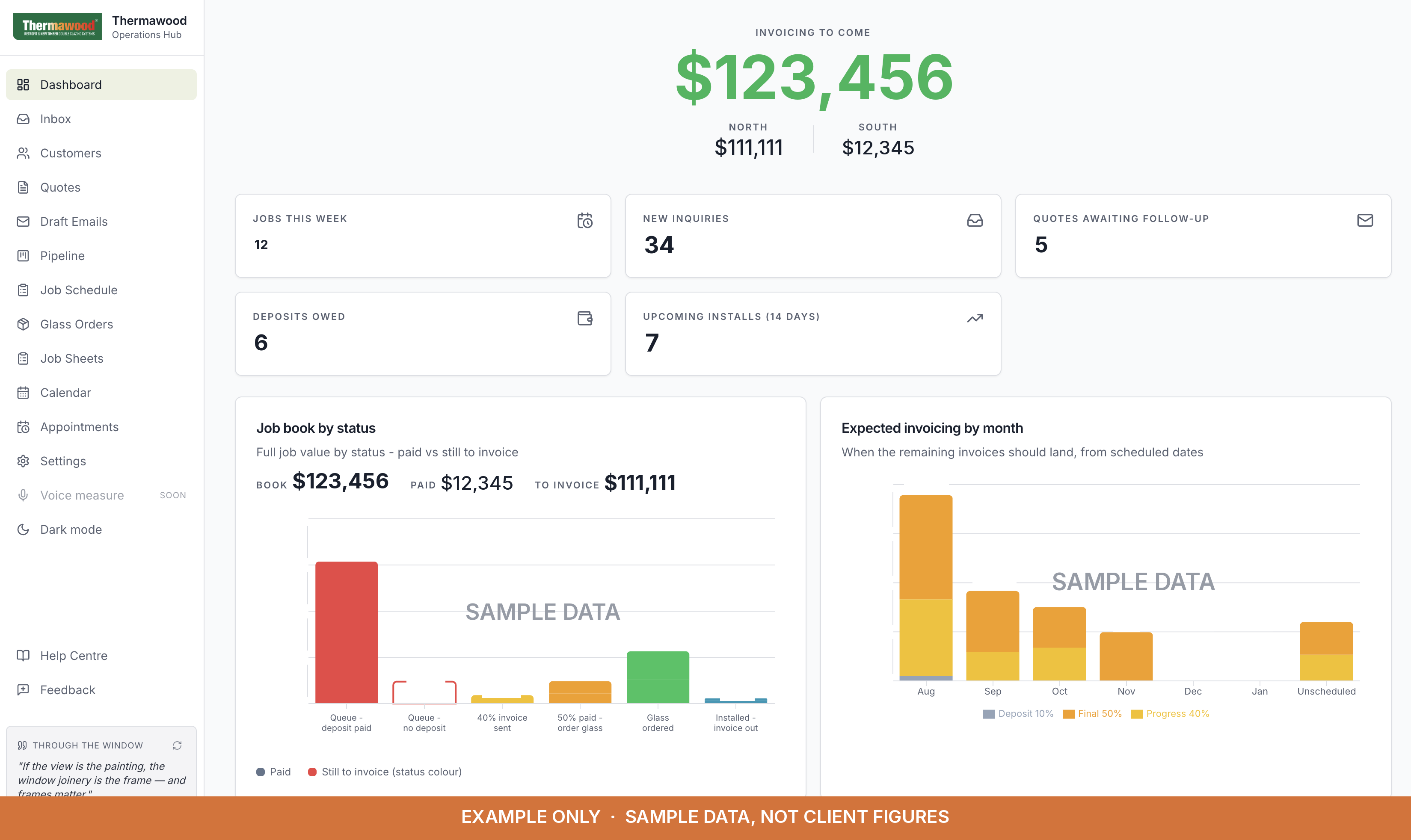
- A pipeline view showing where each job sits, from first contact to installed
02 / Quoting
The part the business lives on, rebuilt from the spreadsheet up.
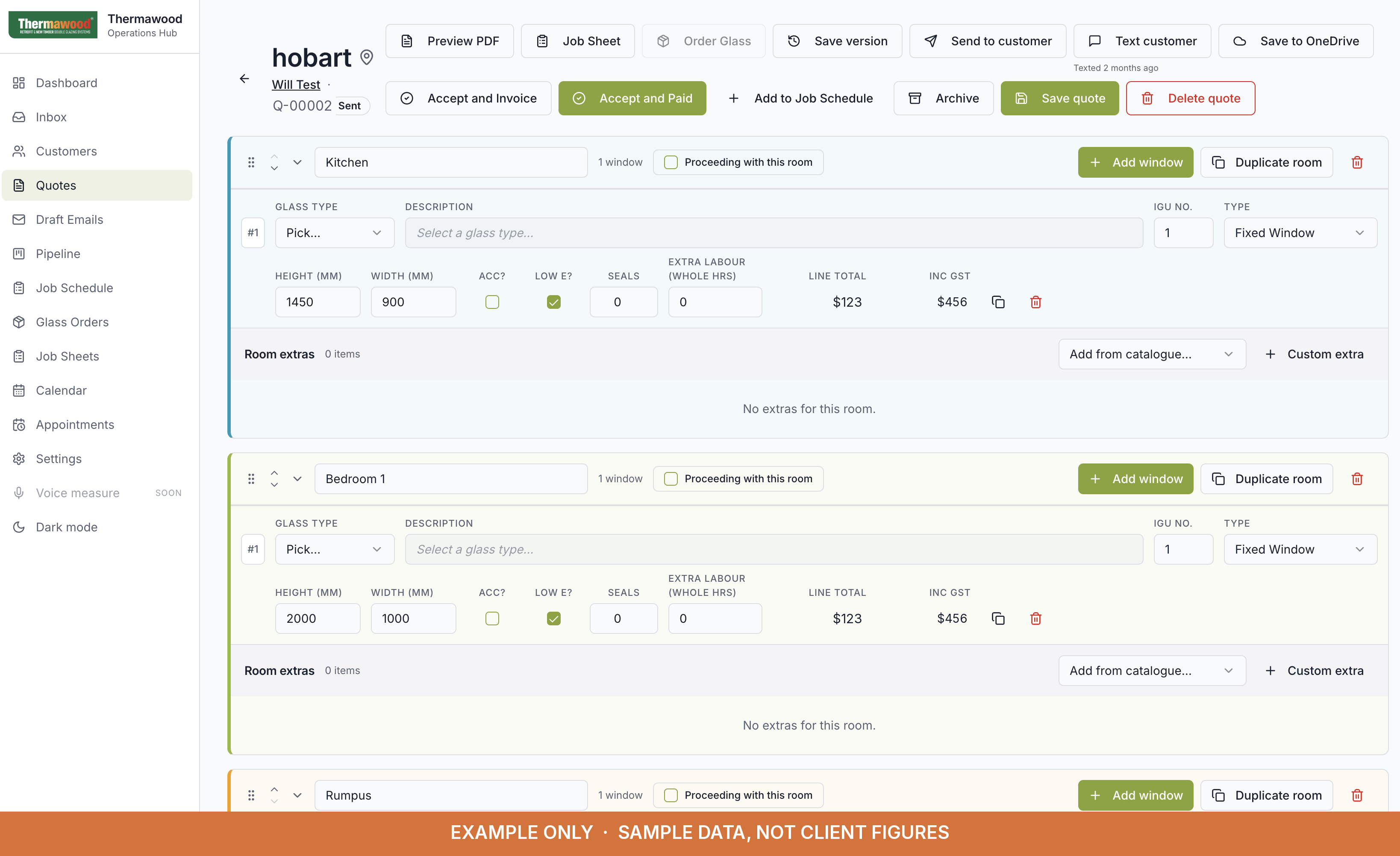
- A room by room builder, with sizing, glass type, seals and labour set per window
- Duplicate a room, reorder rooms, and tick which rooms the customer is proceeding with
- Line totals that update as the numbers are typed
- Version history on every quote, so an earlier price can always be pulled back up
- A generated customer PDF with a cover letter that can be edited before it goes
- Send by email or by text without leaving the app
03 / Scheduling and delivery
From an accepted quote to a van turning up with the right glass.
- A job schedule and calendar, with appointments booked against the job
- Glass ordering raised against each job rather than tracked on the side
- Job sheets with their own PDF and their own version history
04 / Money
Invoicing follows the job rather than somebody's memory.
- Staged invoicing at deposit, progress and final
- Two-way Xero sync, so payments and adjustments made by the accountant come back
- A forward invoicing forecast, laid out by month
- Deposits owed, tracked in one place
05 / Running it
The parts that make it a system somebody can own rather than a prototype.
- Draft emails held ready to review and send
- Admin settings for rates, catalogue items and users
- A help centre with videos, and a feedback widget wired straight to me
- Dark mode
In progress
- Voice measure, so window measurements can be spoken in on site rather than typed
The result
One system in place of the separate ones that came before it. The owner can see the state of every job from one screen.
Follow-up happens because the system carries it, not because somebody remembered. Customers hear back at each stage without anyone setting a reminder to tell them.
This is what a web app looks like when it is built for one business rather than bought off a shelf. Nothing in it is a feature somebody else needed.
- WORKFLOW COVERED
- Enquiry, quote, schedule, install, invoice
- SYSTEMS REPLACED
- Spreadsheets, a calendar and a manual Xero process
- INTEGRATIONS
- Xero two-way sync, Twilio SMS
- APPROACH
- Built in production, incrementally, no downtime
- STATUS
- In daily use, still growing
Want one like this?
Tell me about your project. You get a fixed quote in writing within two business days.
Get a quote